

Stock market boundaries that define speculation and investment
- Business
- 22:04 19/08/2022
DNHN - The boundary between speculation and investing can be thin at times, yet it is still vital to discern between the two since only with proper understanding can one behave correctly. Mr Pham Luu Hung, Chief Economist of SSI Securities Company, considered speculation as gambling because he did not properly assess the risk concerning profit; also consider investing as a cake, just by making assumptions with low reality but giving a very high probability, it is easy to go from hope, illusion, disappointment, and despair.

Mr Hung stated that it is difficult to analyze each person's perspective since each person has various experiences with the stock market, resulting in distinct preconceptions. To put it another way, it's gambling since we don't adequately analyze the risk in connection to the profit, and the cake is simply creating assumptions with low reality but offering a very high chance, or something like that. It is quite easy to go from optimism and delusion to disappointment and sorrow. Speculation or investment is a personal option based on personality and benefit; yet, we must understand what we are doing.
"In my perspective, the boundary between investing and speculation remains the dosage of risk. Speculation has a far larger risk than investing. Investing with leverage will quickly turn into speculation. However, it should be emphasized that the boundary is also fairly unstable, and in any one transaction, it is frequently a combination of two variables "Mr Hung stated.
Mr Hung commented on the prospects of the Vietnamese stock market, stating both the world and Vietnamese stock markets had a volatile first half of 2022, with most estimates for 2022 having to modify very soon. In the medium run, if we solely consider Vietnam's macroeconomic determinants, the current favourable trend remains the most important, with inflation remaining under control in 2022 and economic growth expected to meet and surpass the plan.
However, profit prospects for listed businesses in the second half of the year remain uncertain in the context of growing input prices and slower-than-expected demand growth. In terms of the market, there are currently no indicators that the stock market's troubles from the first half of the year will be remedied anytime soon.
Issues concerning the corporate bond market, the real estate market, and so on, while there are answers from the start, there is still a gap between determination and actual action, and it takes time. Not to mention the delayed deployment of new products/services under the Securities Law 2019, as well as the lack of significant advancements in state-owned business IPO/divestment operations.
In the long run, most of the stories about the prospects of the Vietnamese economy and stock market remain true, such as the increased size and quality of the economy's growth, and the national credit rating has been upgraded to an investable level, or the investor base improves positively with the participation of more domestic and foreign institutional investors, particularly the prospect of Vietnam's stock market being upgraded to emerging markets.
Long-term opportunities are always present, but so are short-term threats, thus investors or speculators must constantly remember the adage "far water cannot save near fire." The portfolio's short-term concerns should always be properly analyzed and addressed, not because the tales are too long-term, but because the portfolio must take unneeded risks.
"Indeed, we must constantly have a long-term perspective, have an opinion on all problems, and make projections, but most importantly, we must know where we are in an economic cycle. To take proper action, consider the stock market cycle. In the current situation, I believe prudence is required; trying to pinpoint the bottom will remain a dangerous game. Much is at stake for the global economy (military conflicts, the end of old-fashioned globalization, the trend of monetary tightening is just getting started, not to mention the epidemic situation) and even for Vietnam (inflation pressure rises in the second half of 2022 and maybe even higher in 2023, while growth appears to be peaking) "- Mr Hung revealed.
As a result, now is the time to restructure the portfolio, reduce the proportion of speculative stocks, stocks in which forecasting the future plays a decisive role in stock prices, and increase the proportion of enterprises that are still doing well now and have survived and developed through many economic cycles of ups and downs.
Short-term prospects for speculating are a lot more difficult than they were two years ago, but long-term investing options are more plentiful when values are much more comfortable. And, even if it's tedious, I must address the problem of risk management, especially in this turbulent market era.
"One well-known example is the case of the Korean fund Uprise, which went bankrupt by shorting LUNA. The lesson is clear: even if you are correct about the trend, poor risk management will result in a loss. In a tumultuous market, money is spent as normal "Mr Hung said.
Huyen Tram (t/h)
Related news
- AgriS receives First-Class Labor Medal
- Vietnam takes APEC baton from China, eyes ‘new era of self-reliance’ for 2027
- Vietnam–UAE CEPA: Tariff Gains Yet to Translate into Market Share
- Vietnam urges Trump to speed up reciprocal trade deal
- AgriS and its chairwoman to receive First-class Labor Orders
- Mr. To Lam at FrancoTech 2026: Francophone cooperation must move from potential to concrete action
- Mandarin orange, mandarin ambitions
- Vietravel Airlines Reinforces Its Board as It Pushes Into Southern China
- Vietnam’s spice exports on track to hit $2.4 billion in 2026
- Vietnam ranks third in Southeast Asia in digital, AI competitiveness
- Better data key to unlocking SME credit
- VINASME calls for data-driven lending to improve SME access to credit
- Vietnam Makes It 10 Straight as Khanh Hoa Drives Golf Tourism Momentum
- Nine banks plan subsidiaries at Vietnam’s international financial center
- Ho Chi Minh City: A Story in Every Rhythm
- A democratic congress could reshape U.S. foreign policy, but President Donald Trump still holds the keys
- Vietnamese exporters face green standards hurdle in EU market
- Vietnam Police Sports Association Teams Up with 90,000-Strong Business Network to Boost Athletics
- Vietnam Foodexpo to host largest edition with over 500 businesses
- Vietnam seeks innovation-led growth amid shifting global economic landscape
Đọc thêm Business
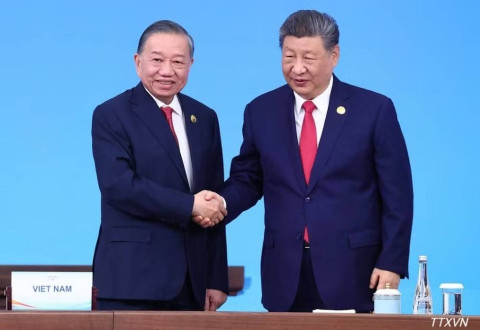
Vietnam takes APEC baton from China, eyes ‘new era of self-reliance’ for 2027
Hanoi unveils theme and three priorities as it prepares to host the forum for the third time, with leaders’ week set for Phu Quoc

VIFC-HCMC courts international capital at Singapore FinTech Festival
At a Singapore workshop, the city’s new financial center outlined four priority product groups and signed a letter of intent with SLEI to broaden Vietnamese businesses’ access to long-term capital.

Vietnam tops ASEAN consumer sentiment despite rising cost concerns
Vietnamese consumers remain the most optimistic in ASEAN with an ACSI score of 63, but rising living costs and gaps in long-term financial security are making them more cautious, savings-minded and investment-oriented

Vietnam–UAE CEPA: Tariff Gains Yet to Translate into Market Share
Nine months into the CEPA, Vietnamese goods enjoy major tariff advantages in the UAE yet hold under 1% of its import market. The greatest potential lies in using the incentives, meeting rules of origin and building distribution networks.

Vietnam urges Trump to speed up reciprocal trade deal
Both sides have held seven formal negotiation rounds and agreed on most of the core content, but no signing date has been set.

Vietnam’s spice exports on track to hit $2.4 billion in 2026
Exports of black pepper, cinnamon and star anise are all posting solid growth, putting Vietnam’s spice industry on course for a turnover of $2.4 billion in 2026.

Vietnam exports $120,000 worth of specialty coffee to US
A company in Vietnam's Central Highlands province of Dak Lak has exported more than 3.4 tons of specialty coffee to the U.S., marking a step toward higher-value exports as the country seeks to move beyond its traditional reliance on raw coffee beans.

Over $480 million pledged at COP31 to accelerate methane emissions reductions
More than $480 million in new climate financing has been announced at COP31 to accelerate efforts to reduce methane emissions and other powerful climate pollutants.
Vietnam raises foreign commercial borrowing ceiling to 10 billion USD for 2026
The Vietnamese Government has raised the ceiling for medium- and long-term foreign commercial borrowing by enterprises and credit institutions to 10 billion USD in 2026.

Better data key to unlocking SME credit
Transparent financial data and standardized credit profiles could help small and medium-sized enterprises access bank financing, while enabling lenders to assess repayment capacity without relaxing credit standards.